
Chemical hazards in propolis: evaluating the risks of pesticide and heavy metal contamination
| dc.contributor.author | Alihanoğlu, Selin | en_US |
| dc.date.accessioned | 2025-12-04T12:07:18Z | |
| dc.date.available | 2025-12-04T12:07:18Z | |
| dc.date.issued | 2025-12 | |
| dc.identifier.citation | Alihanoğlu, S. (2025). Chemical hazards in propolis: Evaluating the risks of pesticide and heavy metal contamination. Paper presented at the Proceedings of FLOTECH-HONEY: Flora, Technology, and Honey: Next-Generation Governance in Beekeeping Workshop, 92-98. https://belgelik.isikun.edu.tr/xmlui/handle/iubelgelik/7135 | en_US |
| dc.identifier.isbn | 9789756494554 | |
| dc.identifier.uri | https://belgelik.isikun.edu.tr/xmlui/handle/iubelgelik/7135 | |
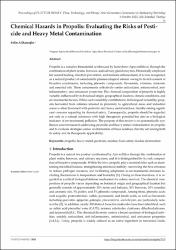
| dc.description.abstract | Propolis is a complex biomaterial synthesized by honeybees (Apis mellifera) through the combination of plant resins, beeswax, and salivary gland enzymes. Historically employed for wound healing, infection prevention, and immune enhancement, it is now recognized as a natural product of considerable pharmacological interest owing to its rich content of bioactive constituents, including phenolic compounds, flavonoids, vitamins, minerals, and essential oils. These components collectively confer antioxidant, antimicrobial, an-ti-inflammatory, and anticancer properties. The chemical composition of propolis is highly variable, influenced by its botanical origin, geographical location, climatic condi-tions, and environmental factors. While such variability contributes to its biological versa-tility, propolis harvested from colonies situated in proximity to agricultural areas and in-dustrial zones is often burdened with pesticide and heavy metal residues, thereby raising significant concerns regarding its chemical safety. Consequently, propolis should be re-garded not only as a natural substance with high therapeutic potential but also as a bio-logical indicator of environmental pollution. The purpose of this review is to systemati-cally synthesize current research addressing pesticide and heavy metal contamination in propolis and to evaluate strategies aimed at elimination of these residues, thereby ad-vancing both its safety and its therapeutic applicability. | en_US |
| dc.language.iso | eng | en_US |
| dc.publisher | Işık University Press | en_US |
| dc.relation.ispartof | Proceedings of FLOTECH-HONEY: Flora, Technology, and Honey: Next-Generation Governance in Beekeeping Workshop | en_US |
| dc.rights | info:eu-repo/semantics/openAccess | en_US |
| dc.rights | Attribution-NonCommercial-NoDerivs 3.0 United States | * |
| dc.rights.uri | http://creativecommons.org/licenses/by-nc-nd/3.0/us/ | * |
| dc.subject | Propolis | en_US |
| dc.subject | Heavy metal | en_US |
| dc.subject | Pesticide | en_US |
| dc.subject | Residue | en_US |
| dc.subject | Food safety | en_US |
| dc.subject | Residue elemination | en_US |
| dc.title | Chemical hazards in propolis: evaluating the risks of pesticide and heavy metal contamination | en_US |
| dc.type | conferenceObject | en_US |
| dc.description.version | Publisher's Version | en_US |
| dc.authorid | 0000-0003-1300-4628 | en_US |
| dc.identifier.startpage | 92 | |
| dc.identifier.endpage | 98 | |
| dc.peerreviewed | Yes | en_US |
| dc.publicationstatus | Published | en_US |
| dc.relation.publicationcategory | Konferans Öğesi - Ulusal - Başka Kurum Yazarı | en_US |
Bu öğenin dosyaları:
Bu öğe aşağıdaki koleksiyon(lar)da görünmektedir.
-
Flora, Technology and Honey: Next Generation Governance Workshop [12]
Flora, Technology and Honey: Next Generation Governance Workshop Bildiri Kitabına ait bildirileri içerir.

Aksi belirtilmediği sürece bu öğenin lisansı: info:eu-repo/semantics/openAccess